

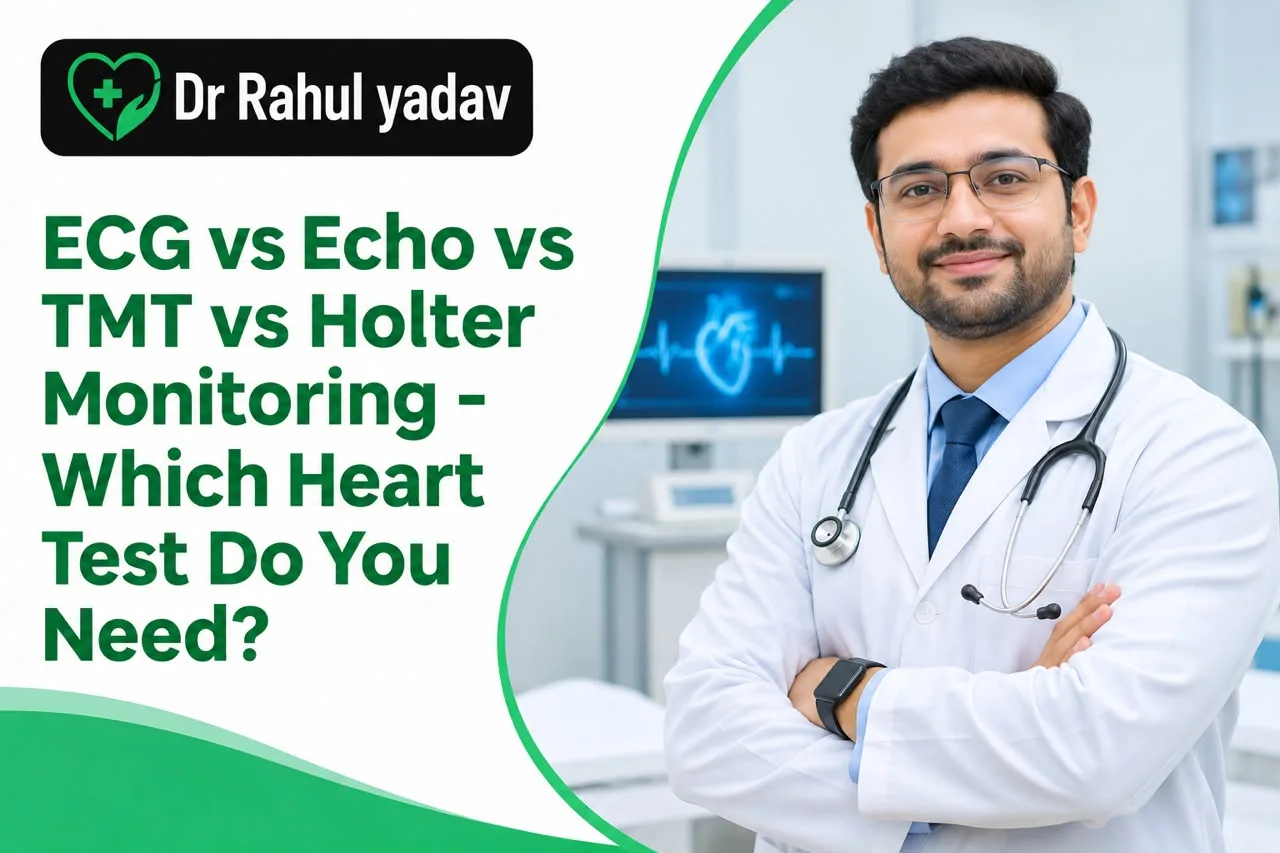
Heart health tests help identify cardiovascular problems, evaluate symptoms, and guide doctors in deciding whether further investigation or treatment is needed. If you experience chest discomfort, an irregular heartbeat, breathlessness, dizziness, or unexplained fatigue, your doctor may recommend one or more cardiac tests. Commonly recommended investigations include ECG, Echo, TMT, and Holter Monitoring. Although all four tests help evaluate heart health, each examines a different aspect of how the heart works. Understanding ECG vs Echo vs TMT vs Holter Monitoring can help you understand why a doctor may recommend a particular test and what information it provides. In this guide, Dr. Rahul Yadav, an interventional cardiologist in Lucknow, is featured in the context of cardiac evaluation, along with an explanation of the different heart tests, their procedures, benefits, and uses.
What Are ECG, Echo, TMT, and Holter Monitoring?
ECG, Echo, TMT, and Holter Monitoring are diagnostic tests used to evaluate different aspects of cardiovascular health. The choice depends on the patient's symptoms, medical history, examination findings, and the clinical question the doctor needs to answer.
Here is a quick overview:
- ECG (Electrocardiogram): Records the electrical activity and rhythm of the heart.
- Echo (Echocardiogram): Uses ultrasound waves to examine the heart's structure, valves, and pumping function.
- TMT (Treadmill Test): Evaluates how the heart responds to physical exercise.
- Holter Monitoring: Records the heart's electrical activity continuously over an extended period, usually 24–48 hours or longer depending on the device.
These tests serve different purposes and cannot replace one another. Depending on the patient's symptoms and medical history, a doctor may recommend a single test or combine multiple investigations to gain a more comprehensive understanding of their heart health.
What Is an ECG Test?
An electrocardiogram, commonly called an ECG or EKG, is a quick, non-invasive test that records the electrical signals the heart generates with each heartbeat. These electrical signals help coordinate the heart's chamber contractions. By recording them, an ECG can show heart rate, rhythm, and electrical conduction.
Why Is an ECG Performed?
An ECG may be recommended to investigate:
- Irregular, unusually fast, or unusually slow heartbeats.
- Chest discomfort or suspected heart-related symptoms.
- Possible signs of a heart attack.
- Dizziness or fainting that may be caused by the heart.
- Certain heart conditions or changes associated with medication.
- Heart function in patients who require monitoring for an existing condition.
An ECG can also be used as part of an initial cardiac assessment. However, a normal ECG does not rule out every heart condition, and additional testing may be necessary when symptoms or clinical findings warrant further investigation.
How Is an ECG Test Performed?
During a standard resting ECG, small adhesive electrodes are placed on the chest and limbs. These electrodes connect to a machine that records the heart's electrical activity. The patient generally lies still for a few minutes while the machine records the signal. The test is usually painless, uses no needles, and does not send electricity into the body. A standard ECG takes only a few minutes to record, although preparation and interpretation may require additional time.
When Might You Need an ECG?
An ECG may be useful when a doctor needs to assess your heart rhythm or investigate symptoms that could indicate a cardiac problem.
Book a consultation with Dr. Rahul Yadav
What Is an Echo Test?
An echocardiogram, commonly called an Echo, is an ultrasound examination of the heart. Unlike an ECG, which records electrical activity, an Echo creates images that show the heart's structure and movement. It helps doctors assess how well the heart chambers, valves, and pumping mechanism are functioning.
Why Is an Echo Test Performed?
An Echo may be recommended to investigate:
- Reduced pumping function or suspected heart failure.
- Heart valve abnormalities.
- Enlargement of the heart chambers.
- Certain congenital heart conditions.
- Fluid around the heart.
- Unexplained breathlessness or other symptoms requiring structural assessment.
- Changes in heart function after selected cardiac events.
An echocardiogram can measure the heart's pumping function, including ejection fraction, the percentage of blood pumped out of the left ventricle with each heartbeat. The findings can help the cardiologist understand whether structural or functional abnormalities may be contributing to the patient's symptoms.
How Is an Echo Test Performed?
For a standard transthoracic echocardiogram, the patient lies on an examination bed while a doctor applies ultrasound gel to the chest. A handheld probe moves across different areas of the chest to capture images of the heart. The procedure is generally painless and uses no ionizing radiation. A standard Echo usually takes about 30–40 minutes, though the duration varies depending on the type of examination and the images required. Other types of echocardiography, such as transoesophageal or stress echocardiography, may involve additional preparation and different procedures.
When Might You Need an Echo?
An Echo may be appropriate when the doctor needs to assess heart structure, valve function, or pumping ability, not just electrical rhythm.
What Is a TMT Test for the Heart?
A treadmill test, also called a Treadmill Test (TMT) or exercise stress test, evaluates how the heart responds when the body becomes physically active. During exercise, the heart pumps more blood to supply oxygen to the muscles. A TMT monitors the heart's electrical activity, heart rate, blood pressure, and symptoms as exercise intensity increases. The results may help doctors investigate selected cases of suspected coronary artery disease or exercise-related symptoms.
Why Is a TMT Test Recommended?
A TMT may be recommended to:
- Investigate chest discomfort associated with physical activity.
- Assess symptoms such as breathlessness or lightheadedness during exercise.
- Evaluate the heart's response as physical workload increases.
- Investigate selected cases of suspected coronary artery disease.
- Help assess exercise tolerance in appropriate patients.
- Evaluate certain exercise-related heart rhythm abnormalities.
A TMT is not suitable for everyone. The doctor must consider the patient's symptoms, medical history, physical ability, and potential risks before recommending the test. Other investigations may be more appropriate in certain circumstances.
How Is a TMT Test Performed?
Doctors attach electrodes to the patient's chest and place a blood pressure cuff on the arm. The patient begins walking on a treadmill at a relatively easy pace. The treadmill's speed and incline are gradually adjusted according to the test protocol. During the procedure, the healthcare team monitors the patient's heart rate, heart rhythm, blood pressure, and symptoms. The test ends when the target level is reached or when symptoms or other medical concerns require it to stop. After the test, the patient remains under observation as they recover.
When Might You Need a TMT?
A TMT may be useful when a doctor wants to understand how your heart responds to exercise. It differs from a resting ECG because it assesses the heart under increased physical demand.
WhatsApp Dr. Rahul Yadav about your symptoms
What Is Holter Monitoring?
Holter Monitoring is a portable cardiac monitoring test that continuously records the heart's electrical activity over an extended period, commonly 24–48 hours or longer depending on the device and clinical requirement. A standard ECG provides a short recording at a single point in time. However, some abnormal heart rhythms occur intermittently and may not appear during a brief examination. Holter Monitoring helps doctors investigate these episodes by recording heart activity as the patient goes about their usual daily routine.
Why Is Holter Monitoring Recommended?
A cardiologist may recommend a Holter monitor for patients experiencing:
- Palpitations or a sensation of a racing heartbeat.
- Episodes of irregular heartbeat.
- Unexplained dizziness or near-fainting.
- Suspected intermittent arrhythmias.
- Symptoms that were not explained by a standard ECG.
- A need to assess how well certain heart rhythm treatments or medications are working.
The monitor records electrical activity throughout the monitoring period. Doctors can then compare the results with a diary of symptoms and activities to determine whether symptoms coincide with abnormal heart rhythms.
How Is Holter Monitoring Performed?
Doctors place small adhesive electrodes on the patient's chest and connect them to a portable recording device. The patient wears the device during regular daily activities and follows the doctor's instructions. Keeping a symptom diary can help record episodes of palpitations, dizziness, or other concerns. After monitoring, the patient returns the device or downloads the recorded data for analysis. The cardiologist reviews the results to determine whether further tests or treatment are needed. Patients should keep the device dry and follow specific instructions regarding bathing, exercise, and device care throughout the monitoring period.
When Might You Need Holter Monitoring?
It may be particularly useful when symptoms come and go, and a short ECG recording doesn't capture the suspected abnormality.
ECG vs Echo vs TMT vs Holter Monitoring: Key Differences
The main difference between these four tests is the type of heart information each provides.
| Feature | ECG | Echo | TMT | Holter Monitoring |
|---|---|---|---|---|
| Main purpose | Records electrical activity | Examines heart structure and function | Evaluates response to exercise | Records heart rhythm over time |
| Test method | Electrodes and ECG machine | Ultrasound imaging | Treadmill exercise with monitoring | Portable ECG recorder |
| Exercise required | No, for a resting ECG | No, for a standard Echo | Yes, usually | No formal exercise required |
| Typical duration | A few minutes for recording | Around 30–40 minutes for a standard Echo | Varies with preparation, exercise, and recovery | Usually 24–48 hours or longer |
| Main uses | Rhythm assessment and selected cardiac abnormalities | Pumping function, valves, and structure | Exercise-related symptoms and selected cases of suspected coronary disease | Intermittent abnormal heart rhythms |
| Radiation | No | No ionizing radiation | No | No |
The duration and suitability of each test depend on the type of investigation and the patient's medical condition.
Which Heart Test Is Best for You?
The most appropriate diagnostic test varies from patient to patient. Doctors choose investigations based on symptoms, medical history, suspected condition, and initial assessment results to determine the next steps in care.
For Chest Pain
A doctor may recommend an ECG as part of the initial assessment. Depending on your symptoms and clinical findings, a doctor may also require an Echo, a stress test, blood tests, or other investigations. New, severe, persistent, or recurring chest pain can be a medical emergency. Do not wait for a routine appointment or an outpatient test if you suspect a heart attack.
For Irregular Heartbeat
An ECG may identify an abnormal rhythm if it occurs during the recording. If symptoms are intermittent and the ECG doesn't capture them, the doctor may recommend Holter Monitoring or another ambulatory heart rhythm monitor.
For Breathlessness or Suspected Reduced Pumping Function
An Echo may help assess the heart's pumping function, chamber size, and valves. Additional tests may be required to identify the underlying cause.
When Symptoms Occur During Physical Activity
A TMT may be considered when exercise-related symptoms require evaluation, and the patient is suitable for an exercise test. The cardiologist may select an alternative investigation depending on the patient's risk profile and clinical circumstances.
For a More Complete Cardiac Assessment
Some patients require more than one test because each investigation answers a different clinical question. For example, an ECG assesses rhythm, an Echo examines the heart's structure, and an ambulatory monitor investigates intermittent symptoms. The cardiologist determines which tests are appropriate.
Are ECG, Echo, TMT, and Holter Monitoring Safe?
These tests are commonly used in cardiac evaluation, but their preparation, limitations, and risks differ.
- ECG: It is a safe, painless, non-invasive test. Some patients may experience mild skin irritation from the adhesive electrodes.
- Echo: A standard transthoracic echocardiogram is generally painless and does not involve ionizing radiation. Specialized types may require additional preparation.
- TMT: A treadmill test involves supervised exercise with continuous monitoring. It may be unsuitable for patients with certain acute or unstable heart conditions.
- Holter Monitoring: Holter monitoring is generally safe and non-invasive. However, the adhesive electrodes may occasionally cause skin irritation.
Patients should inform their doctor about their symptoms, medications, allergies, and relevant medical conditions before testing. They should also follow the preparation instructions given for the specific procedure.
Meet Dr. Rahul Yadav, Interventional Cardiologist in Lucknow
Dr. Rahul Yadav is an interventional cardiologist practicing in Lucknow. His clinical services include coronary angiography, angioplasty, pacemaker implantation, and other catheter-based cardiac procedures. He emphasizes evidence-based decisions, personalized treatment planning, compassionate care, and regular follow-up. In cardiac care, choosing the right diagnostic test is a key step in understanding a patient's condition.
Depending on the symptoms and examination findings, a cardiologist may recommend tests to assess electrical activity, heart structure, exercise response, or intermittent rhythm abnormalities. Dr. Rahul Yadav's clinical practice includes evaluating and managing heart conditions for patients across the areas he serves in Lucknow, with treatment decisions guided by the patient's clinical history, test results, and individual needs. If you've noticed symptoms like the warning signs that mean it's time to see a cardiologist, discuss the purpose of a recommended heart test with your treating doctor to understand what it can detect, its limitations, and whether additional investigations may be needed.
Schedule a cardiac evaluation today
Conclusion
ECG, Echo, TMT, and Holter Monitoring are important diagnostic tools, but each evaluates a different aspect of heart health. An ECG records electrical activity, an Echo assesses heart structure and pumping function, a TMT evaluates the heart's response to exercise, and Holter Monitoring records heart rhythm over an extended period. Understanding ECG vs Echo vs TMT vs Holter Monitoring can help you better understand your doctor's recommendations. However, no single test fits every situation, so choose based on your symptoms, medical history, and clinical assessment. If you have concerns about your heart health, consult a qualified cardiologist for an appropriate evaluation and personalized guidance.
FAQs
What is the main difference between ECG and Echo?
An ECG records the heart's electrical activity and rhythm, while an Echo uses ultrasound to create images of the heart's structure, valves, and pumping function. The tests provide different information and may both be needed.
What is the difference between ECG and TMT?
A resting ECG measures the heart's electrical activity over a brief period while the patient remains at rest. In contrast, a treadmill test (TMT) monitors cardiac electrical activity, heart rate, blood pressure, and symptoms during physical exertion.
Is Holter Monitoring better than a normal ECG?
Neither test is better for every situation. A standard ECG records the heart's electrical activity for a brief period, whereas Holter monitoring captures it continuously over a longer duration. Holter monitoring may help when symptoms occur occasionally and are unlikely to appear during a routine ECG.
Can an Echo detect blocked heart arteries?
A standard Echo examines the heart's structure and function, but it does not directly show coronary artery blockages the way coronary angiography does. Additional testing may be needed when coronary artery disease is suspected.
Does a normal ECG mean my heart is healthy?
A normal ECG does not always rule out a heart condition. Although the results can be reassuring, some conditions may not show up on a brief recording. If symptoms persist or the clinical findings raise concerns, the doctor may recommend further tests or investigations.
How long do these heart tests take?
A standard ECG takes a few minutes, a standard echo usually takes about 30–40 minutes, and a TMT includes preparation, exercise, and recovery. Holter Monitoring usually involves wearing the device for 24–48 hours, or longer if needed.
Which heart test is recommended for palpitations?
An ECG is often the first test used to assess heart rhythm. However, if palpitations occur intermittently and aren't captured during the recording, a cardiologist may recommend Holter monitoring or another ambulatory heart rhythm monitor for further evaluation.
When should I consult a cardiologist?
Consult a cardiologist for recurring palpitations, unexplained breathlessness, dizziness, chest discomfort, or other symptoms that may be heart-related. Seek emergency medical attention for severe or persistent chest pain, especially when accompanied by sweating, nausea, or breathlessness.